On Skills and Growth - How to Love the Plateau
Most people's mental model of skill development looks like this: steady upward slope, consistent returns, effort in equals progress out. The model is wrong, and the wrongness matters.
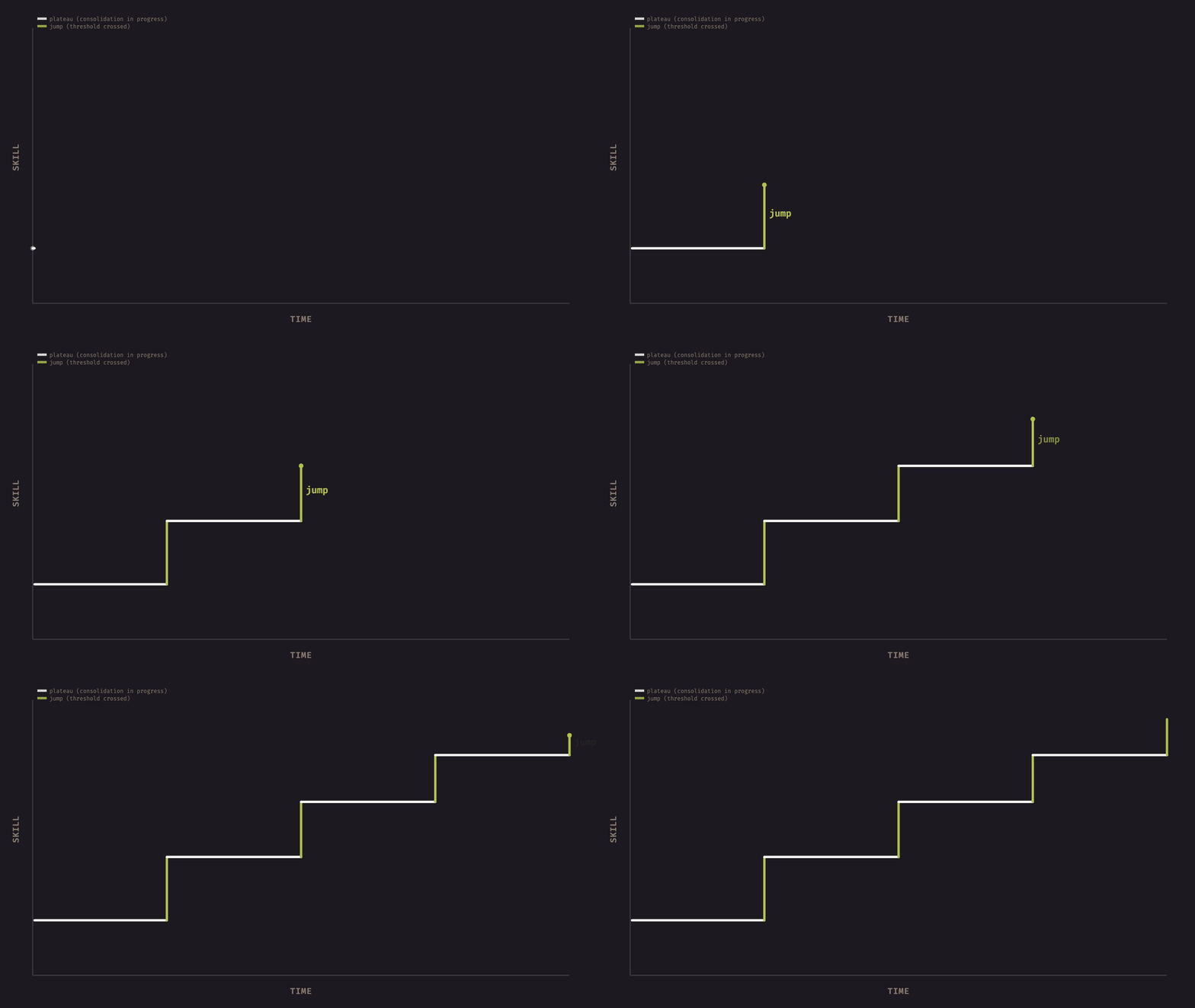
Progress in complex skills follows a stepwise function. Long stretches of flat, then a sharp jump, then another flat. Repeat. The flat parts are not failure states or rest periods; rather, they are the mechanism. The jump cannot happen without the plateau that precedes it. George Leonard spent a career documenting this in Mastery: the subsurface consolidation that precedes visible progress, the way the ceiling pressures before it breaks.
That part is well understood. Here's the part that isn't.
People know this. They've been told it. They nod along. And then they quit, or thrash, or switch to something that still has the dopamine of visible progress. The failure is not epistemic; it is motivational. And the motivational failure has a structural cause: human motivation runs on variable-ratio reinforcement. Progress is the reward signal. The plateau removes it.
So the question "how do you love the plateau?" is really a question about what you run on when the feedback is gone.
Three structurally different answers exist, and they matter because they imply different interventions:
Process signal
the practice session becomes the reward unit, not the outcome it builds toward. People who reach this state have switched fuel, not increased willpower. When I recognize that I am on a plateau, this is usually the reserve I reach for: shifting the reward from progress to the act of practice itself.
Identity decoupling
the practitioner has separated their identity from outcome metrics. Progress rates become information rather than self-assessment. The plateau cannot threaten what it cannot measure. For me, this has meant learning to treat slow periods in my work not as verdicts on ability, but as signals about where the process currently sits. The absence of visible progress is often the surface indicator that something deeper is still forming.
Long time horizons
very low discount rates on future returns. Willingness to wait longer between reward events because the evaluation timescale has extended. In my own work, this has meant deliberately stretching the horizon on which I evaluate progress on hard things; accepting that many of the systems I care about building (ideas, research, architecture, projects, teams) compound on timescales longer than the feedback loops most environments optimize for.
Most "love the plateau" advice conflates these three or offers the first as if it's the only one. Leonard's prescription is love the work. Accurate direction; however, it is an underspecified path. The harder question is why this is difficult in the first place.
The answer is structural: process quality is not observable at scale. You cannot rank people on whether they're doing productive plateau work or stagnant plateau work. You can rank them on test scores, promotion rates, revenue numbers, Github stars, patents filed, lines of code shipped. Outcome metrics exist because they are legible. Goodhart's Law completes the circuit: once a progress measure becomes the target, it stops tracking what it was supposed to measure. The institutional stack (schools, performance reviews, promotion ladders, engagement metrics) is built on legible outputs. It has been since Frederick Taylor systematically replaced craftsperson process knowledge with measurable task output. That replacement was not neutral. It trained every institution to mistake the signal for the thing.
Leonard saw this clearly:
"Where in our upbringing, our schooling, our career, are we explicitly taught to value, to enjoy, even to love the plateau?"
The answer is nowhere. And the consequence is that a large portion of any mastery-oriented life will be spent in what he called "restless, distracted, ultimately self-destructive attempts to escape it."
But here is the distinction Mastery doesn't make explicit, and it's the one that makes the advice safe to follow.
Two kinds of plateau exist.
Productive plateaus
consistent quality practice is occurring, subsurface consolidation is in progress, the ceiling is being pressured.
Stagnant plateaus
the practitioner has stopped pressuring the skill ceiling, the work is comfortable, the consolidation process has nothing to work with.
"Love the plateau" is sound advice for the first. For the second, it is actively harmful: a justification for staying comfortable and calling it discipline.
A useful test: am I doing work that pressures my current ceiling, or work that stays safely inside it? Discomfort at the right edge is the signal. Its absence on a plateau is a warning.
The institutional dimension compounds this. Loving the plateau is not just a psychological posture; it is a partially adversarial relationship with the systems you operate within. Those systems inject synthetic progress signals (grades, metrics, ratings, rankings) and therefore own the motivation of anyone running on them. Decoupling from those signals is the actual mechanism, not the aspiration.
The people who pull this off have usually done one of two things: insulated themselves from the institutional punishment for outcome-indifference (financial runway, job security, reputation buffer), or found niches where process-orientation is structurally preserved (research labs, elite training programs, craft traditions that survived industrialization). A one-week plateau is annoying. A two or three-year plateau with no institutional cover is career-threatening. That context dimension usually goes unspoken in the advice.
Reduced to first principles, progress in complex skills happens below the surface before it appears above it. Feedback systems are tuned to surface appearance. Therefore, feedback systems systematically mislead you about whether you are improving. The three paths (process signal, identity decoupling, long time horizons) are three different ways of building confidence in internal signals when external ones have gone quiet.
That confidence is what loving the plateau actually means. The sentiment follows from it; it doesn't produce it.